Why We Gain Weight After Menopause (and Why Eating Less Isn't the Answer)
You’re eating much the same way you always have, you’re active, and your weight has barely changed for most of your life. Then suddenly you’re updating your wardrobe because nothing fits quite the way it used to.
Maybe you’ve looked at your body and thought, When did this change?
A woman in my Peri Gut Plan community recently told me that she and her friends, all healthy, active women in their mid-sixties, were having the same experience. Their eating habits hadn’t changed, but their clothes no longer fitted the way they once did.
She wanted to know: is this happening to other women our age too?
The short answer is yes. All the time. And if this sounds like you, I want you to remember:
You haven’t done anything wrong.
There are some very normal physiological reasons your body can change as you move through menopause and beyond. Understanding them can help take some of the frustration and guilt out of it.
What’s really happening in your body
Ageing and menopause are happening at the same time, and both can affect your muscle, fat stores and the way your body manages blood glucose.
We naturally lose muscle as we get older, and the menopause transition may add to that decline. Muscle helps keep you strong, supports your metabolism and plays an important role in managing blood glucose. As muscle mass falls, your body may need less energy than it once did. This means eating exactly as you always have can affect you differently now.
Lower oestrogen also changes where your body tends to store fat. More may settle around your middle rather than your hips and thighs, which is why your clothes can stop fitting even when the number on the scales has barely moved. Your shape may be changing more than your size.
Insulin sensitivity can decline with age too, and sometimes our everyday movement changes without us noticing. Your walks might become a bit shorter, your pace slows down or we spend more time sitting than we used to. That won’t be true for every woman, but it can add to the other changes happening in the body.
Put it all together, right when life is already full, and it makes sense that your old approach may no longer give you the same result.
Why simply eating less isn’t the whole answer
When we notice weight creeping on, most of us reach for the same lever: eat less. It’s the message many of us have absorbed our whole lives.
I understand the pull of it. Years ago, when my own gut was struggling, I tried every quick fix going. Cutting out gluten, cutting out dairy, cleanses, you name it. It took me a while to see that I wasn’t giving my body what it needed.
Cutting your food back too far makes it harder to get enough protein and other nutrients, and can increase the amount of muscle you lose. In your sixties and seventies, that can leave you feeling weaker, more tired and less able to do the things you enjoy.
This is why I’d rather help you eat smarter than simply eat less.
What to focus on instead
Start with three things.
Protein spread across your day
Protein helps you maintain muscle as you age, especially when you pair it with strength work. Include a useful serve at each main meal, such as eggs and yoghurt, fish, chicken, tofu, legumes or lean meat.
Protein needs vary, but around 20 to 30 g or more at each main meal can be a useful place to start.
Fibre from a variety of plants
This one is close to my heart as a gut health dietitian. Fibre feeds your gut microbes, supports regular bowels and helps meals keep you satisfied for longer.
Include vegetables, fruit, legumes, wholegrains, nuts and seeds across your week. Around 7 to 10 g of fibre at each main meal is a useful target, building up low and slow if your gut is sensitive.
Strength work
Using your muscles against resistance, whether that’s weights, bands or your own body weight, is one of the most useful things you can do as you age. It helps maintain muscle and strength, and supports the way your body manages blood glucose.
Start where you are and build from there. Then make sure you’re eating enough to fuel the movement you’re doing. Nourish your body, use your muscles and stay as consistent as you can.
A word on HRT
Because it almost always comes up, menopausal hormone therapy is not a weight-loss treatment, although it may help reduce the accumulation of fat around the middle.
Starting MHT is generally considered most favourable before age 60 or within 10 years of menopause. If you’re in your sixties or seventies and many years beyond menopause, the conversation is more individual and needs to take your symptoms, health and personal risk factors into account. Speak with your GP or a menopause-informed doctor about what is appropriate for you.
What I really want you to remember
Some change in your shape as you age is normal, and it isn’t automatically a sign that something is wrong. Your health cannot be summed up by a clothing size or the number on the scales.
Pay attention to your strength, energy, blood pressure, blood glucose, cholesterol, gut symptoms and whether your body still lets you do the things you enjoy.
The goal I want for you is not a smaller body. It’s a strong, well-nourished one that lets you keep doing what you love for as long as possible.
Eating enough protein, building strength and feeding your gut well can help you feel more comfortable, more energetic and more like yourself again. To me, that’s what ageing well looks like.
If this resonated and you’d like some support nourishing your gut and your body through perimenopause and beyond, that’s exactly what we do inside the Peri Gut Plan.
We give you a clear plan for building meals around protein, fibre and variety, so you know what to eat and where to start. There is a kinder and far more useful way forward than simply eating less and hoping.
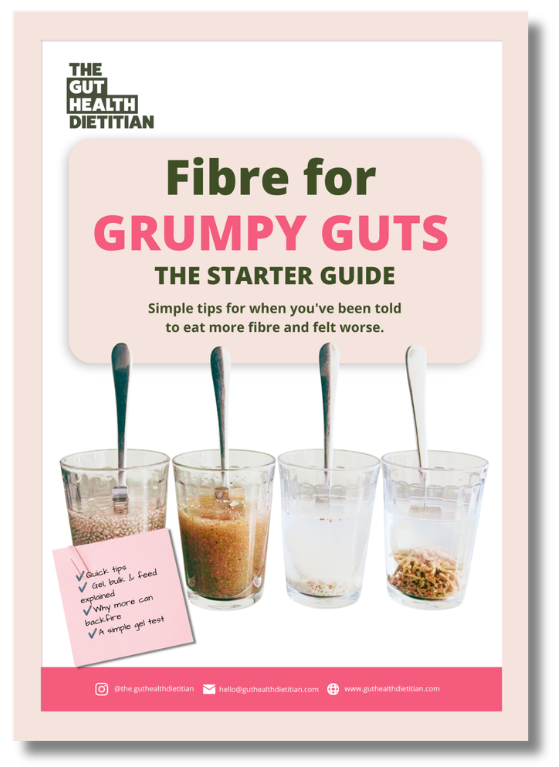
Eating more fibre and feeling worse?
You asked for it, so I'm putting it together.
Fibre for Grumpy Guts is coming.
Maybe you added bran, seeds and a big bowl of lentils, and now you're more bloated and constipated than ever. Or you've cut out onion, garlic, bread and beans and you're still not comfortable. Often the trouble isn't fibre itself. It's the type of fibre, and the order you add it in.
I'm putting together a simple, step-by-step mini-course to show you which fibre to start with, how much and when, and how to build up from there without the bloat.
If that's something you'd like, join the waitlist so I know you're keen. You'll get my free starter guide straight away, and first access when doors open, with a founding price just for waitlisters.
And follow @the.guthealthdietitian on Instagram for more fibre tips while I finish it.
You are signing-up for notification ONLY by completing this form. No tricky stuff! We promise never to spam you.