Alcohol Sensitivity in Menopause: Why One Drink Feels Like Three

Have you ever poured a glass of wine and thought, “Wow… that hit me a lot harder than it used to”?
If so, you’re in good company. I’m hearing this from women every single week, and honestly, I’ve noticed it myself too. One or two drinks that once felt fine now seem to make you feel dreadful the next day.
So let’s talk about what’s going on.
Why alcohol starts affecting you differently
Women have always metabolised alcohol differently because we generally have:
fewer alcohol-processing enzymes
less total body water for dilution
So alcohol takes longer to clear our system.
But during perimenopause, this becomes much more obvious.
The drink hasn’t changed, your internal chemistry has.
The hormone piece
Hormone fluctuations change the way your body responds to alcohol:
Estradiol swings can make alcohol feel more intense and may impact your mood or emotions.
Sleep becomes more unsettled, so alcohol that once did not affect you now triggers broken sleep or that classic 2am wake-up.
As muscle mass changes, alcohol distributes differently through your body.
Please know that it is not all in your head. Your hormone changes are impacting how alcohol feels.
The gut piece (most women never get told this)
This part matters just as much, especially in your 40s.
Perimenopause affects your gut function in ways that make alcohol more impactful:
Gut motility slows, so alcohol sits in the stomach longer and is absorbed more quickly.
Gut permeability increases (partly from hormonal changes and partly from alcohol itself), which can leave you feeling puffy, inflamed or off the next day.
Your microbiome changes, making bloating, constipation, cramps or diarrhoea more likely after even a small amount of alcohol.
So when you feel terrible the next day after just two drinks, this is why.
Your body simply is not processing alcohol the way it did in your 20s or 30s.
So you might notice:
- Feeling tipsy faster
- Emotional reactions that surprise you
- Worse sleep
- Next-day gut symptoms
- Cravings
- Bigger energy fluctuations
- Feeling puffy or inflamed
Once you connect the dots, it makes so much more sense.
How to enjoy the holidays without feeling awful the next day
You absolutely can still enjoy a drink. You just need a few tweaks.
1. Pace yourself
Alternate drinks with water or sparkling water. Simple, but it makes a huge difference.
2. Keep mixers clean
Sugary cocktails lead to blood sugar spikes and headaches.
Wine spritzers, dry bubbles or spirits with soda are easier on your body.
3. Drink earlier
Your sleep and hormones will thank you for it.
4. Notice your personal triggers
For some it is red wine.
For others, champagne.
No right or wrong. Just patterns.
5. Support your gut
Eat before you drink.
Get your fibre in during the day.
Add fermented foods regularly. Your gut microbes need the support.
A reminder
Perimenopause changes so much more than hormones.
Your gut, liver, microbiome and sleep patterns are all different now.
So if alcohol suddenly feels stronger, it is not a personal failing or a lack of tolerance.
It is simply your physiology shifting and your body asking for a slightly different approach.
When you understand what is happening, it becomes much easier to enjoy the season without the next-day fog or gut flare-ups.
References
Barone, J., Ross, J., Nagpal, A., Guzman, G., Berenz, E., Pang, R., & Eisenlohr-Moul, T. (2023). Alcohol use and motives for drinking across the menstrual cycle in a psychiatric outpatient sample.. Alcoholism, clinical and experimental research. https://doi.org/10.1111/acer.14971.
Islam, N., Shihab, S., Kanani, D., & Vegunta, S. (2024). (066) EXPLORING THE IMPACT OF ALCOHOL ON SEXUAL FUNCTION IN PERIMENOPAUSAL WOMEN. The Journal of Sexual Medicine. https://doi.org/10.1093/jsxmed/qdae054.061.
Fucho, G., Delgado, L., González-Rodríguez, A., Guàrdia, A., Álvarez, A., Crivillés, S., Barbero, J., Monreal, J., Labad, J., & Vidal, P. (2022). The impact of sexual hormones on depressive symptoms and alcohol use in a woman with delusional disorder at the perimenopausal stage: case report and review of recent works. European Psychiatry, 65, S863 - S863. https://doi.org/10.1192/j.eurpsy.2022.2238.
Reisel, D., Kamal, A., Glynne, S., & Newson, L. (2024). Menopause and Risk-Taking Behaviours: A Cross-Sectional, Online Survey. BJPsych Open, 10, S74 - S74. https://doi.org/10.1192/bjo.2024.232.
Jenczura, A., Czajkowska, M., Skrzypulec-Frankel, A., Skrzypulec-Plinta, V., & Drosdzol-Cop, A. (2018). Sexual Function of Postmenopausal Women Addicted to Alcohol. International Journal of Environmental Research and Public Health, 15. https://doi.org/10.3390/ijerph15081639.
Phillips, G., Wise, L., & Harlow, B. (2007). A prospective analysis of alcohol consumption and onset of perimenopause.. Maturitas, 56 3, 263-72 . https://doi.org/10.1016/j.maturitas.2006.08.008.
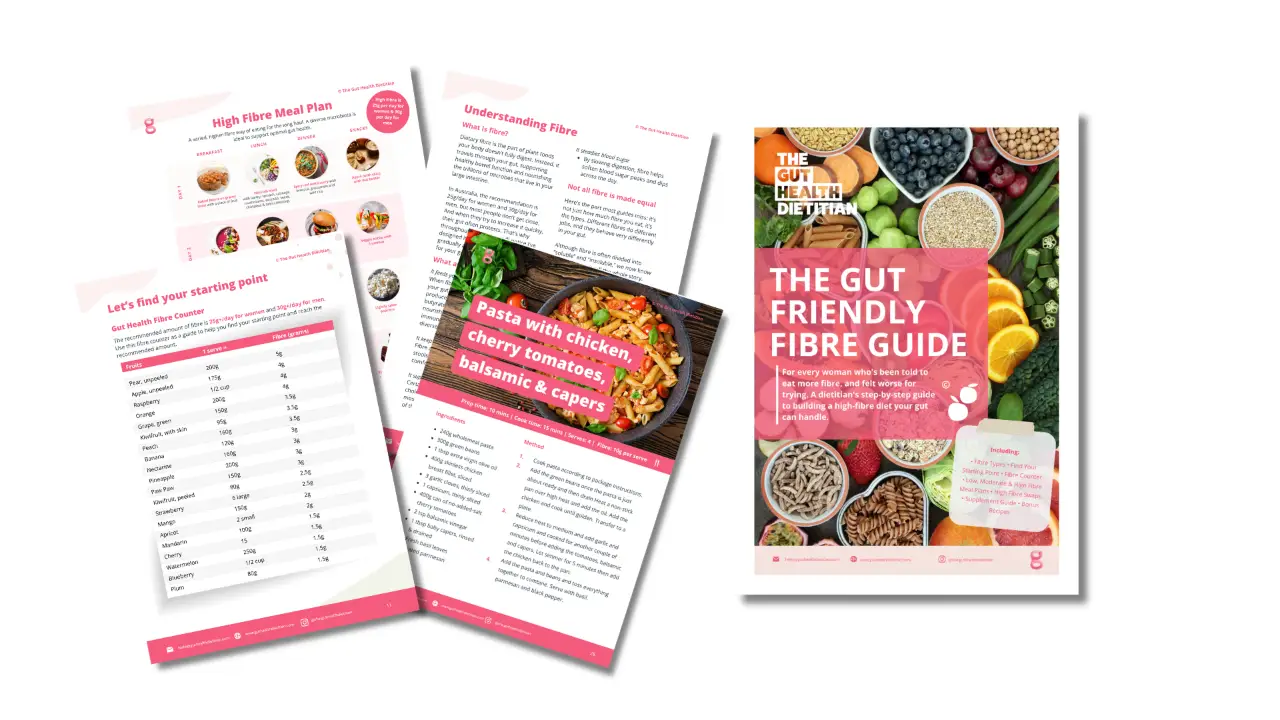
THE GUT FRIENDLY FIBRE GUIDE
An evidence-based guide for women to eat more fibre without making their gut feel worse
If eating more fibre has ever left you feeling worse, fibre probably wasn’t the problem. More likely, your gut just needed you to go slower.
This guide is based on the approach I use with women who want to eat more fibre without making their gut feel worse. We start with where you are now, then build from there slowly enough that your gut can keep up.
It’s food-first, weight-neutral and evidence-based, created by me and my team of Accredited Practising Dietitians.