Why INcluding, not EXcluding, is the way forward this year

You may have noticed something important: habits aren’t just about what we do, but how we respond when things don’t go to plan.
This is something many people recognise at this time of year. New Year goals often focus on restriction, and when routines are disrupted, it can be difficult to adapt, experiment, and stay engaged with change, often slipping into all-or-nothing thinking.
Why Curiosity Matters in Habit Change
Nutrition habits are often the first to become rigid in January. When results don’t appear quickly, many people assume they’ve failed and abandon their efforts altogether.
Behavioural science shows that curiosity keeps habits alive by reducing self-judgement and increasing learning. Instead of labelling foods or days as “good” or “bad,” we approach nutrition as a series of small experiments.
Rather than asking, “Why can’t I stick to this?”, we shift to more helpful questions:
-
What’s influencing my behaviour right now?
-
What happens if I try a small variation?
This mindset builds resilience and supports long-term consistency.
Practising Behavioural Flexibility with Gut Health
We encourage you to avoid focusing on restriction this year, and instead consider how small nutritional changes affect how you feel. Think of yourself as running low-stakes experiments, rather than aiming for perfect execution.
You might try one or more of the following:
Swap the behaviour, keep the cue
If your usual habit isn’t possible, replace it with a simpler version. If a planned gut-health meal feels overwhelming, try a more achievable alternative.
For example:
-
A full “balanced bowl” becomes yoghurt with berries and seeds and muesli.
-
A home-cooked cooked dinner becomes a "Plan B" option - a pouch of soup but with added tinned beans and leafy greens.
Change the environment slightly
Small changes in timing, location, or sequence can dramatically change how a habit feels. Some women notice differences when:
-
eating breakfast a little earlier or later
-
spacing meals more evenly across the day
-
avoiding very large late-night meals
The goal is to observe, not to optimise perfectly.
Introduce one gut-supportive addition
Rather than cutting foods out, try adding one supportive element to your day. Focus on what you can INclude, not EXclude. Shifting the focus from what to exclude to what you can include is particularly relevant when it comes to gut health.
Our gut microbiota thrives on diversity, and small additions, such as an extra vegetable, a different grain, or a new plant food, can help nourish a broader range of beneficial microbes. Approaching nutrition with curiosity allows you to notice changes in digestion, energy, or overall wellbeing without the pressure of “getting it right.”
Notice the impact
After trying a variation, reflect briefly:
-
Did this feel easier or harder?
-
Did it improve energy, focus, or mood?
Remember, there are no “right” answers, only information.
When Habits Feel Hard
Difficulty doesn’t mean the habit is wrong. It often signals:
-
competing demands,
-
low energy,
-
or a mismatch between the habit and your current context.
Curiosity allows you to adjust without quitting.
This Week’s Reflection
At the end of the week, consider:
-
What food or timing change felt most supportive?
-
Did anything improve digestion, energy, or mood?
-
What feels realistic to carry forward into the rest of the year?
Sustainable nutrition isn’t built on perfection, it’s built on learning how your body responds and responding with flexibility.
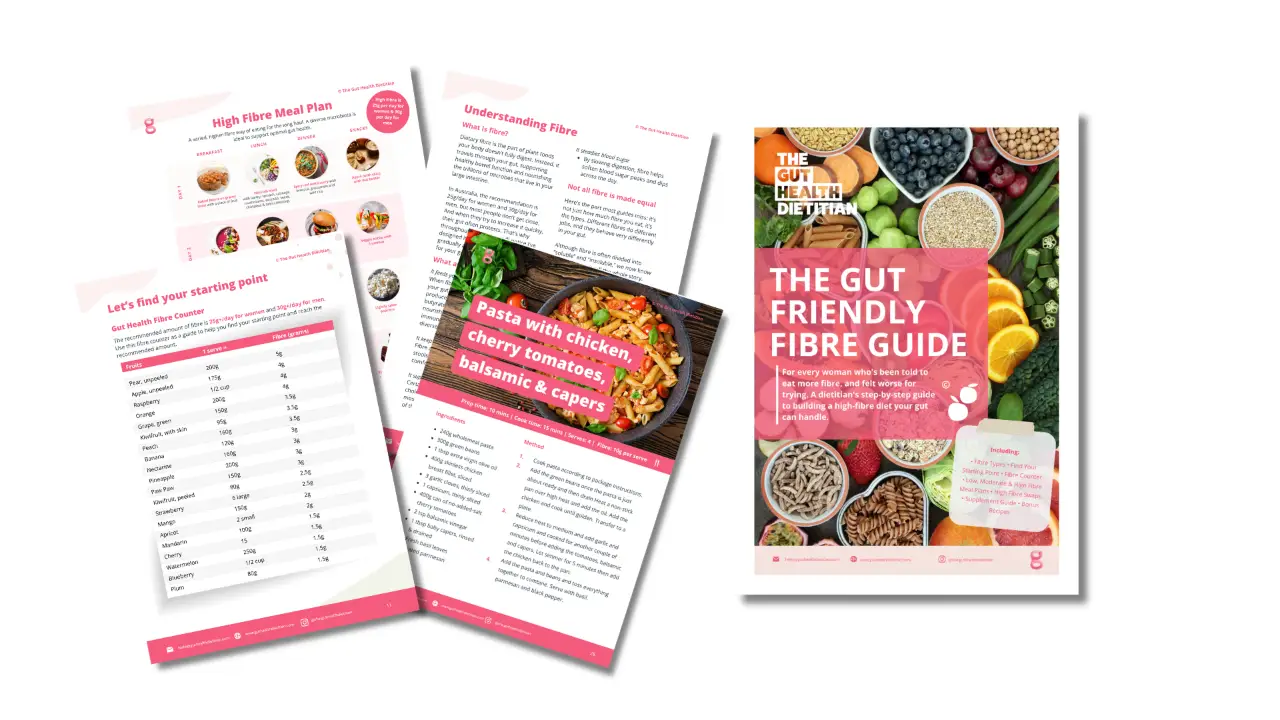
THE GUT FRIENDLY FIBRE GUIDE
An evidence-based guide for women to eat more fibre without making their gut feel worse
If eating more fibre has ever left you feeling worse, fibre probably wasn’t the problem. More likely, your gut just needed you to go slower.
This guide is based on the approach I use with women who want to eat more fibre without making their gut feel worse. We start with where you are now, then build from there slowly enough that your gut can keep up.
It’s food-first, weight-neutral and evidence-based, created by me and my team of Accredited Practising Dietitians.